Agentic data preparation platform
PrepPilot
An open-source coding agent that turns natural-language requests into reproducible data preparation, AutoML, and analysis workflows.
- Project
- Undergraduate thesis and open-source project
- Role
- AI agent architecture, full-stack engineering, and applied research
- Focus
- LLM agents, Data preparation, AutoML, Open source
- Stack
- Next.js 16, React 19, TypeScript, FastAPI, Python, Pandas, scikit-learn, Plotly, LangChain, OpenAI / Anthropic, Prisma, MongoDB, Docker
The project
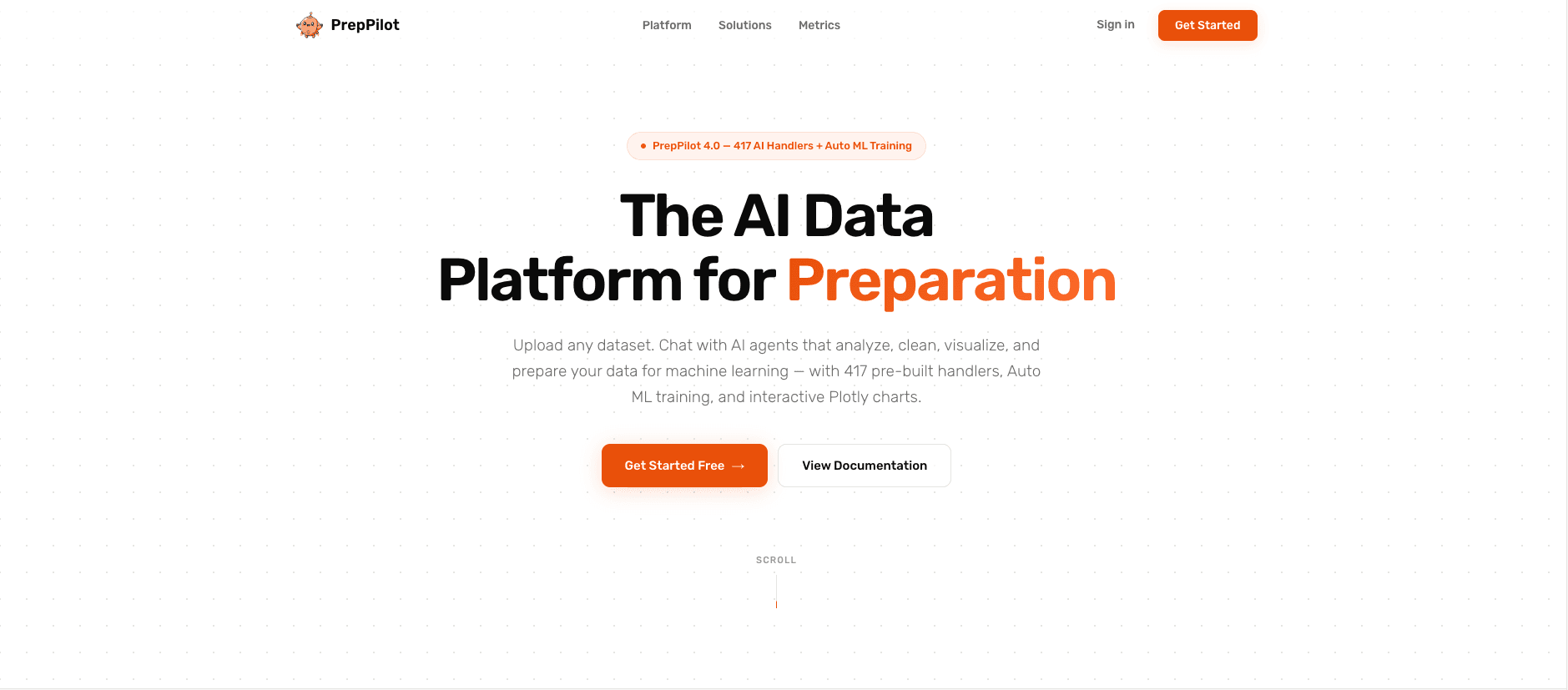
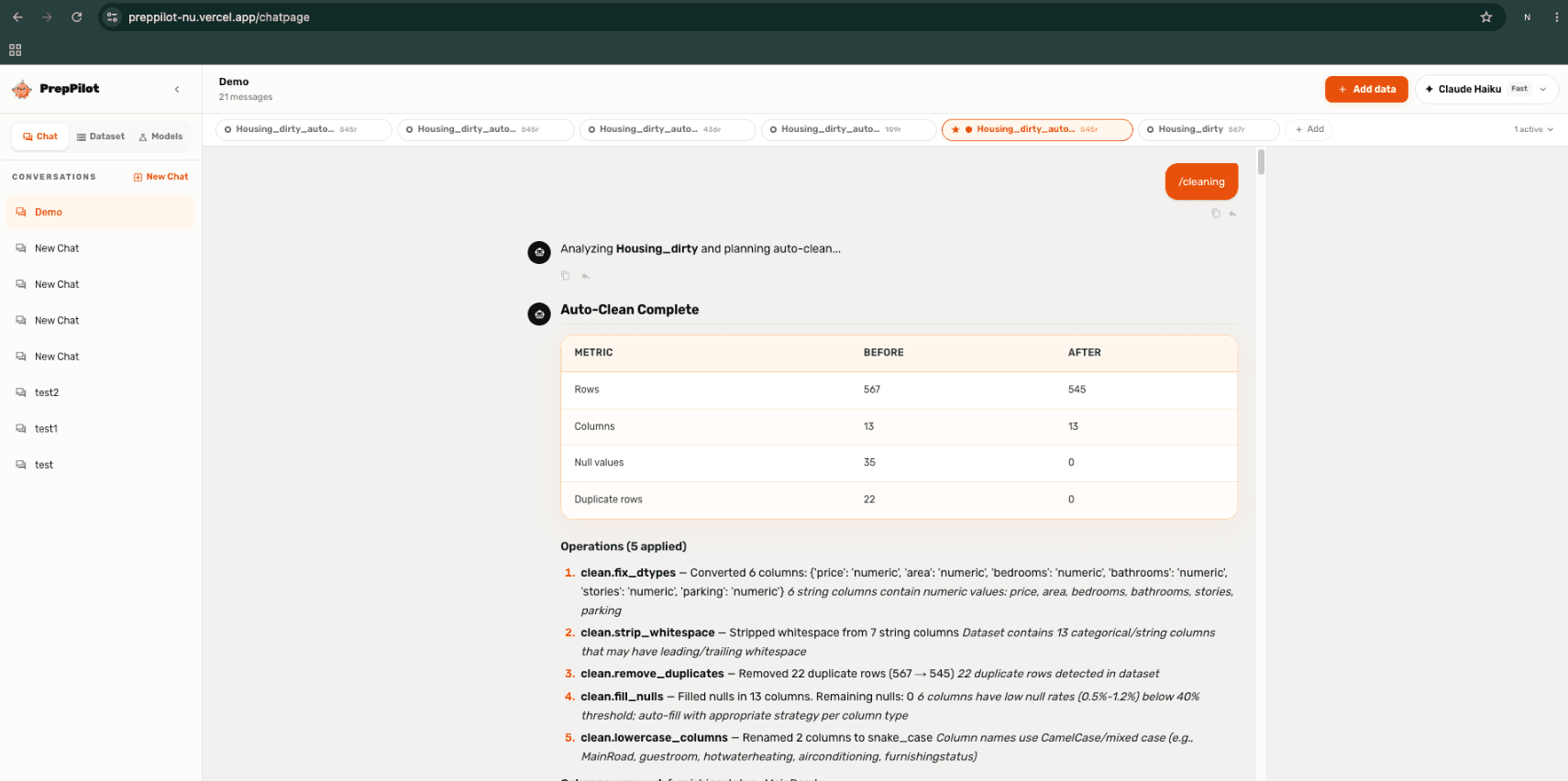
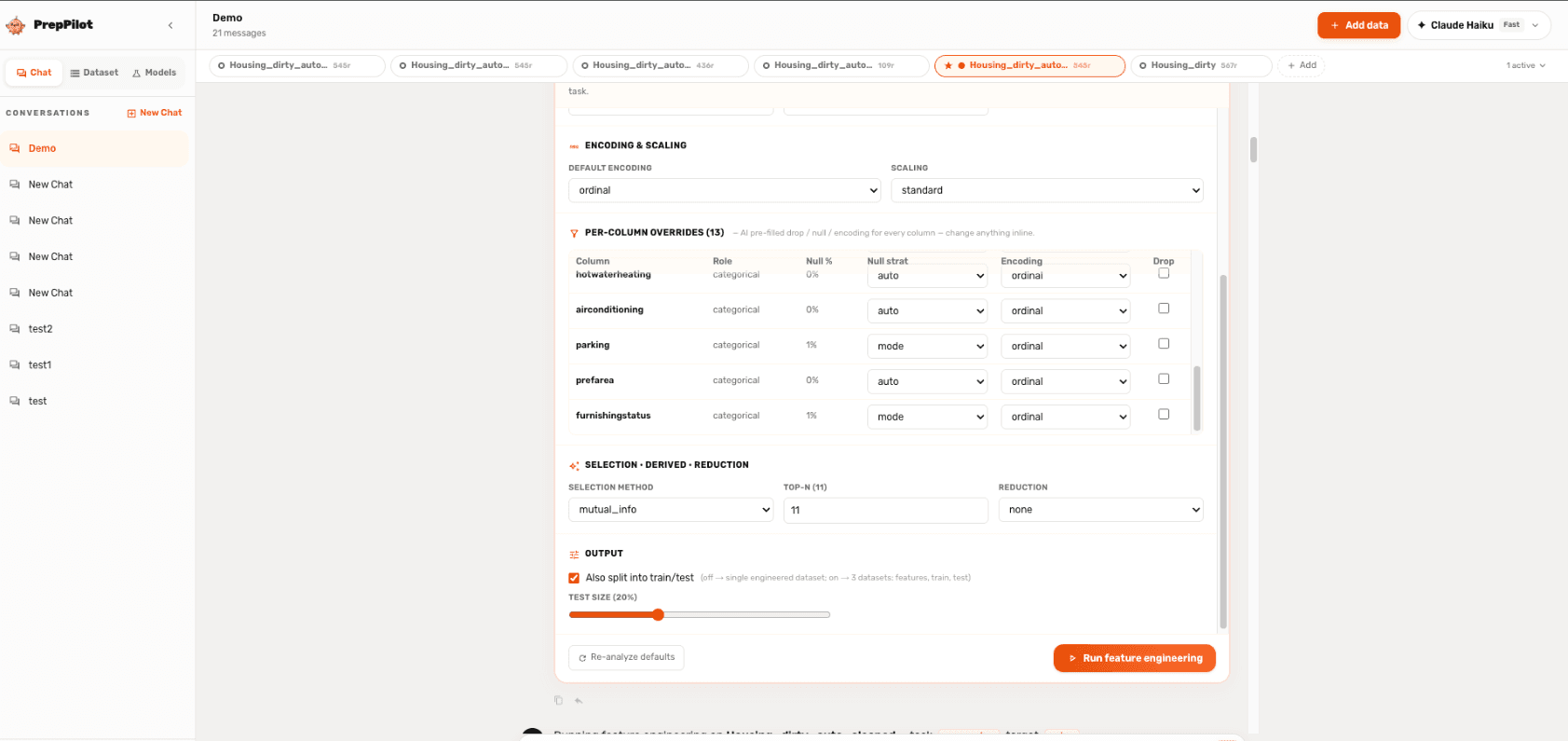
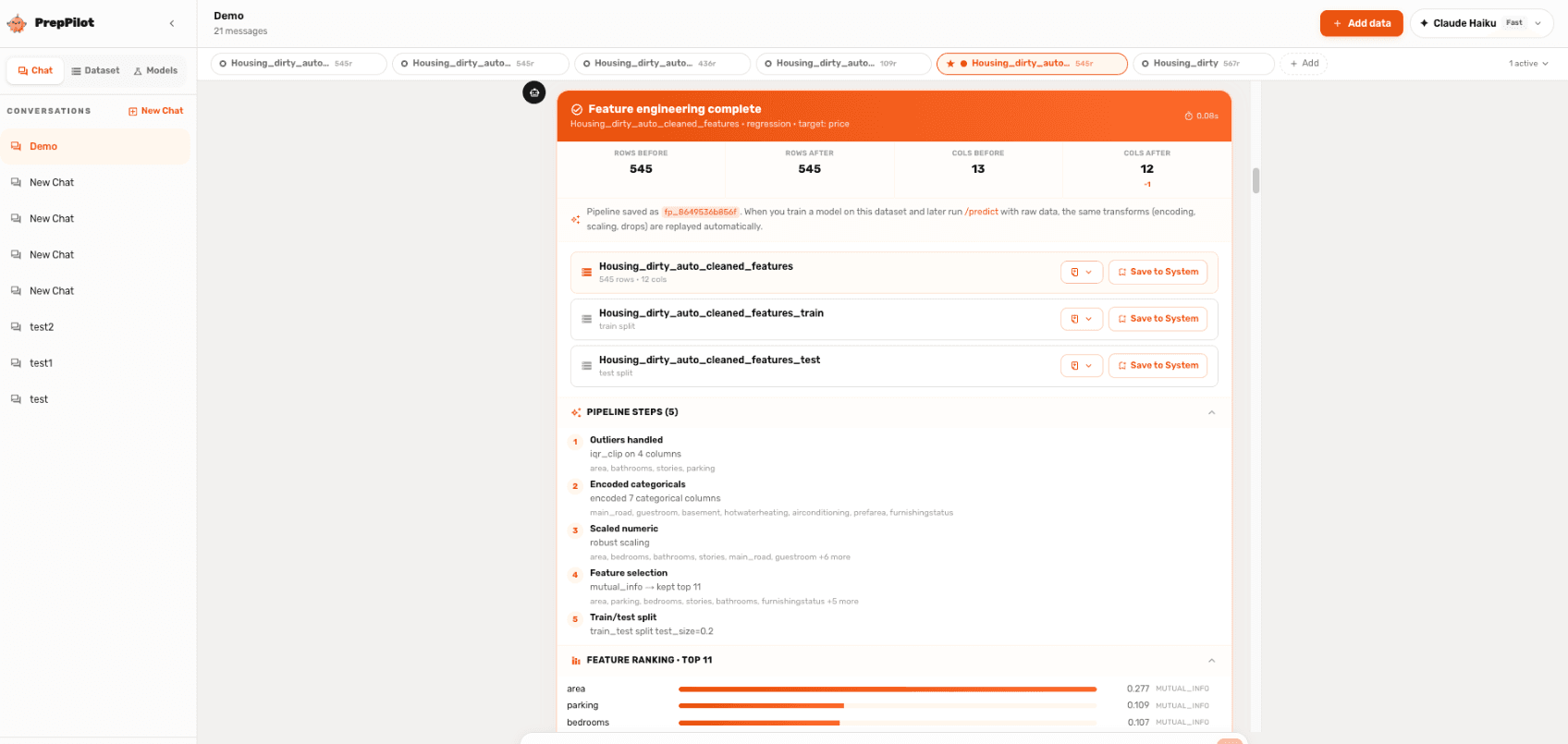
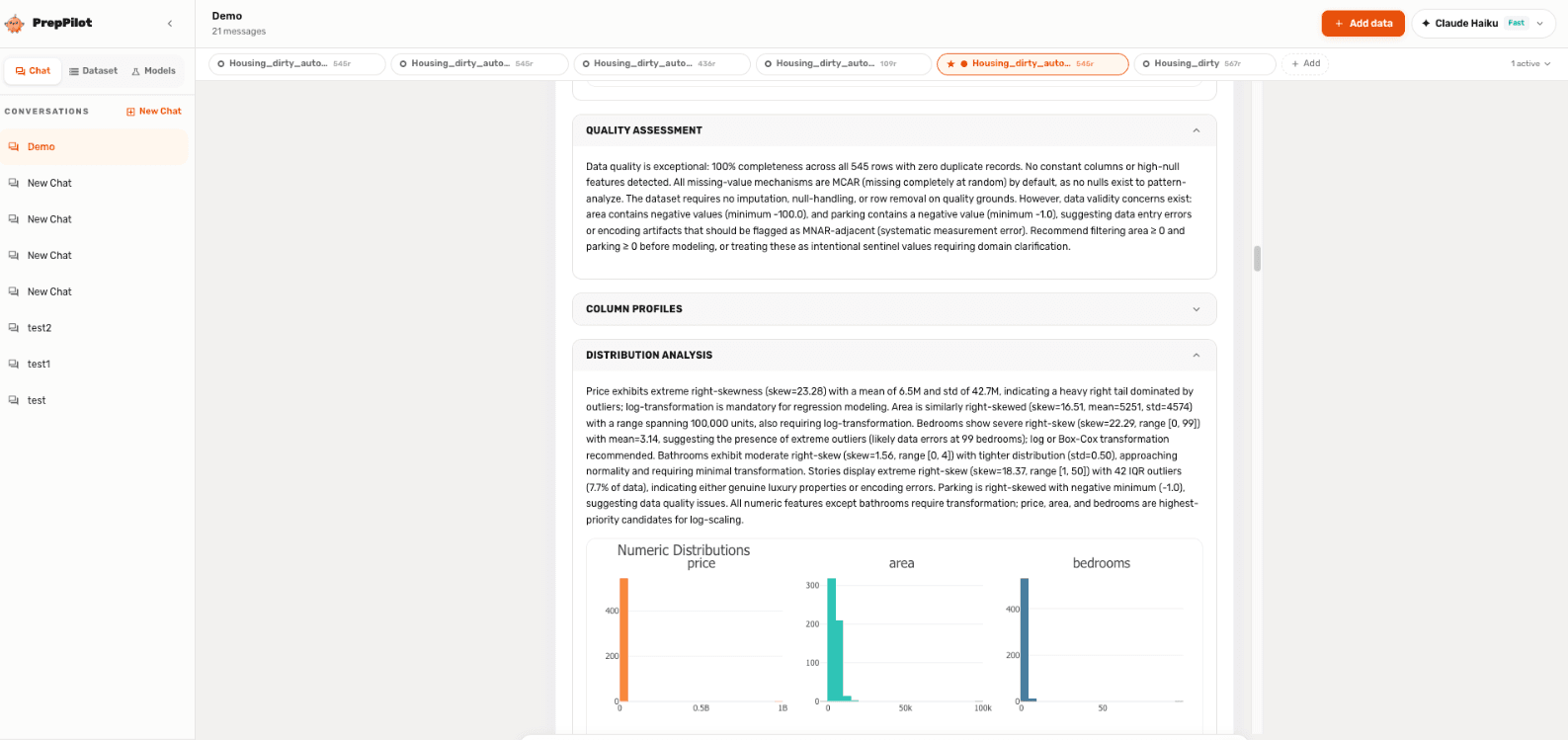
PrepPilot is an undergraduate thesis and open-source AI data-science workspace for people who need to prepare and model datasets without hand-writing every pipeline. Users upload data, describe the outcome in conversation, review the agent's plan and editable configuration, then receive cleaned datasets, interactive analysis, trained models, and prediction outputs in one workspace.
- Provides 417 registered handlers across statistics, cleaning, transformation, visualization, feature engineering, NLP, and analysis.
- Keeps common operations deterministic while preserving a sandboxed code-generation fallback for requests outside the handler catalog.
- Carries work from raw dataset inspection through cleaning, feature preparation, model training, evaluation, and prediction in one conversational workspace.
Product flow
How it works
- 01
A user uploads a dataset in one of 20+ supported formats and attaches it to a persistent conversation.
- 02
A lightweight router narrows the request to one or more of seven data-science categories before a focused planner selects from 417 registered handlers.
- 03
The executor runs a deterministic handler when possible, or generates Python in a constrained sandbox with an automatic retry path for custom work.
- 04
Guided workflows clean data, engineer features, train and evaluate models, generate reports, and save reusable datasets or prediction artifacts.
System design
How it was built
Built the authenticated workspace in Next.js 16 and React 19 with dataset tabs, conversation history, configurable preparation panels, and interactive Plotly artifacts.
Designed a FastAPI multi-agent backend spanning routing, planning, execution, interpretation, critique, and replanning, with OpenAI and Anthropic model support.
Implemented AutoML across 27 supervised and unsupervised algorithms with five-fold cross-validation, Optuna tuning, model storage, and a Docker-based installation path.
System source
Project repositories
- 01web-appNext.js product interface, authentication, persistence, and API proxy layer.
- 02ml-datascienceFastAPI agent system, handler registry, sandbox execution, and machine-learning workflows.
- 03documentsThesis report, system architecture, research diagrams, and product evidence.
- 04demo-repositoryPublic demonstration repository for the Deepcoding Agent organization.
- 05installation-coreCross-platform launcher and Docker orchestration for the web and ML services.